When a Correction Is Not a Reversal
Learn how to read a news correction, identify what changed, and decide which parts of a report still hold without treating every edit as a reversal.
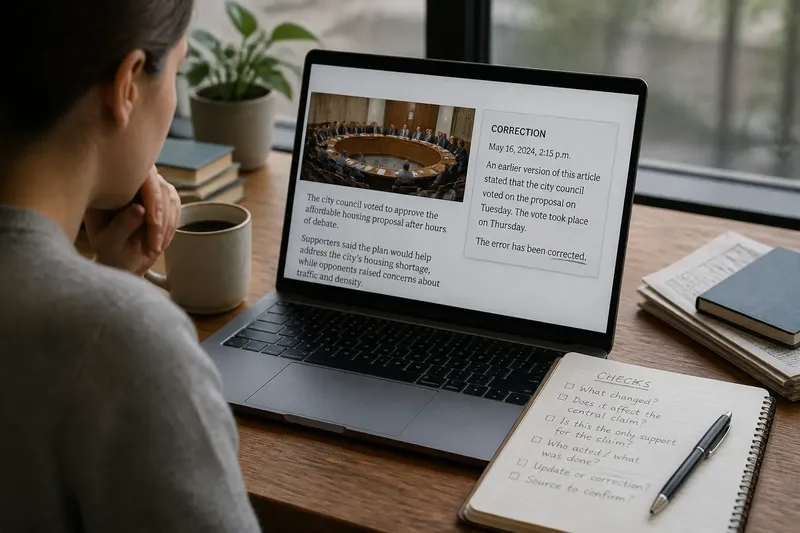
The most common mistake with a news correction is treating any change as proof that the whole story has collapsed. That can leave you repeating a claim the newsroom has withdrawn—or discarding parts that remain intact. Read the notice as a map of what changed, not as a verdict on every sentence.
A correction repairs a factual error; a clarification makes wording more precise; a reversal changes the story’s central account. Those labels help, but the practical question is what the revised information means for the claim you care about.
Follow what the correction changes
Find the exact detail named in the notice, then read the surrounding passage. Is the change about a person’s name, a date, a location, the sequence of events, or the account’s central claim? A small edit can have a large consequence if the rest of the story depends on it.
Say you read an invented report that a city council voted on a proposal Tuesday. A correction changes the day to Thursday, while the vote, its result, and the cited meeting record remain the same. You would replace the incorrect day and retain the reported outcome. If Thursday was the scheduled vote and it had not yet happened when the report appeared, you would instead stop treating the outcome as established.
The useful test is dependency: what claims relied on the detail that changed? A misspelled name may not affect the account if the person’s identity is otherwise clear. But if the report attributed a consequential statement to the wrong person, that error can undermine a central point.
Decide what to carry forward
Start by stating the report’s central claim in plain language. Then compare that claim with the revised version. If the correction changes only a supporting detail, keep the claim in view while replacing that detail. If the change removes the claim’s only support, set the claim aside until the revised account explains what remains.
When a specific detail matters to your use of the story, inspect it directly. Open a linked document, meeting record, or statement if one is available, and compare the corrected wording with that material. A change to a date, title, or quotation may matter to a class discussion or workplace decision even if the broader account still holds.
If the notice says only that the story was “updated for accuracy,” it does not tell you what to revise in your understanding. Look for an editor’s note, a timestamped explanation, or a later version that names the change. If those are missing, leave the affected point unresolved rather than assuming either that nothing important changed or that the entire report is false.
Distinguish repairs from changes in meaning
A correction should identify a factual error and its repair: for example, a wrong location or a quotation attributed to the wrong speaker. A clarification may instead explain a distinction that the original wording blurred. Neither label, by itself, tells you how much the change matters.
Imagine an invented report first says a public meeting was closed. A clarification explains that the meeting was open, but one portion was closed. The meeting still took place, yet readers should revise their understanding of public access. The clarification has a concrete consequence even though it does not replace the story’s central event.
Watch especially for changes to who acted, what they did, and whether an event occurred. If a report says someone approved a plan and the revised account says that person only recommended it, responsibility has shifted. Read the amended passage rather than relying on the label “clarification.”
Check whether an update adds news or repairs an error
An update may add a response, a document, or another later development without saying the earlier version was wrong. A correction addresses an error in what was published. Some pages combine both, so read the note instead of guessing from the time stamp.
Look for an explanation of when the page changed and what was changed. If the report has been substantially revised, an editor’s note may clarify whether an earlier claim was withdrawn, narrowed, or left in place. When sharing the story, link to its current page and mention a consequential correction instead of circulating an old excerpt without context.
Use these checks to decide what remains
- Check whether the notice names a specific sentence or detail; if it does, compare that passage with its surrounding text, but if it does not, look for an editor’s note or keep the affected point unresolved.
- Check whether the change affects the report’s central claim; if it does not, retain the claim while replacing the wrong detail, but if it does, pause before repeating the claim.
- Check whether the changed detail is the only support for a conclusion; if it is, set that conclusion aside until the revised account supplies support, but if other support remains, assess the claim against that material.
- Check whether the change identifies who acted or what they did; if responsibility shifts, revise your account of the event, but if only a spelling or title changes and identity stays clear, keep the broader account in view.
- Check whether the notice describes a later development or an error in the earlier version; if it adds new information, treat it as an update, but if it repairs a false detail, stop relying on that detail.
- Check whether a linked record or statement addresses the corrected point; if it does, compare the wording directly, but if no source is linked, rely on the newsroom’s explanation only as far as it clearly goes.
What should you do when a correction is unclear?
What should I read first?
Read the correction notice and the passage it identifies together. The notice describes the change; the surrounding text shows how that change fits the rest of the report.
Does a corrected number overturn the story?
Not automatically. If the number supports the main conclusion, check whether the revised value changes that conclusion; if it is background, replace the detail without assuming the entire account has changed.
What if the notice does not explain the change?
Look for a fuller editor’s note or a revised passage that names the affected claim. Until then, treat that point as unresolved and avoid presenting either version as settled.
When should I treat a correction as a reversal?
Treat it as a possible reversal when the revised account changes whether an event happened, who made a decision, or what the evidence supports. Follow the substance of the new wording, even if the newsroom uses another label.
Keep a precise account of the revised story
A useful way to check your understanding is to write one sentence separating what remains from what changed. Imagine an invented local report says a school board approved a closure plan after a vote. A correction explains that the vote only scheduled a discussion. The revised sentence would be: “The board voted to schedule a discussion; the report no longer says it approved the closure.” That preserves the meeting and the vote while removing the unsupported outcome.
When a news correction affects your understanding, keep the corrected detail out of anything you repeat, and carry forward only claims the revised account still supports. For a news correction you cannot resolve from the notice, leave the disputed point open; that is more accurate than turning a narrow repair into a total collapse or treating a reversal as a footnote.