How the Press Roundup Took Shape Before the News Feed
Trace how press roundups moved from clipping files to online digests, and learn to recognize what their choices reveal about the coverage they gather.
The common mistake with a press roundup is to treat it as a neutral bundle of clippings; the cost is mistaking a selected set of reports for the full record. Press roundup history is not a straight march from newspaper columns to news feeds. It is a history of recurring editorial choices: what to gather, how to arrange it, and who the collection is meant to serve.
Those choices took different forms as newspapers, clipping services, broadcast monitoring, email, and websites changed how coverage could be collected and circulated. The tools shifted; the roundup’s basic job remained recognizable: bringing related material together for a reader who could not, or did not want to, track every source separately.
Press roundup history begins with clipping and digesting
Before online feeds, readers and organizations used printed digests and press-clipping services to keep track of coverage. A clipping service gathered articles that matched a client’s interests; a digest might summarize or excerpt selected material. Newspaper columns and periodicals also collected reports and commentary around a subject, though their purposes and audiences varied.
These forms were not interchangeable. A clipping file could preserve what publications had printed, while a digest condensed material for quick reading. A newspaper’s roundup could place selected accounts within its own editorial frame. In each case, the collection reflected a decision about what counted as relevant, not a complete inventory of everything published.
Print imposed a visible constraint: pages, column space, and the time needed to assemble material. A clipping file could grow, but a reader still had to sort through it. The format’s appeal was practical. It gathered scattered coverage in one place and made it easier to scan for recurring subjects or notable differences.
Broadcast monitoring added another kind of roundup
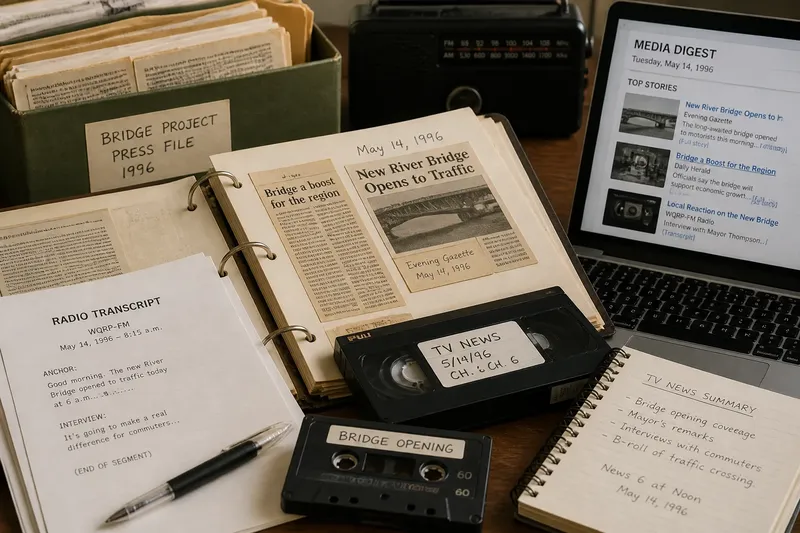
As radio and television news became part of public and organizational life, monitoring services added broadcast material to the broader practice of collecting coverage. Transcripts, summaries, and recordings could help a reader track what had been said on air, alongside newspaper reporting. The resulting roundup was no longer only a stack of printed articles; it could be a record assembled across media.
That expansion changed the material but not the editorial task. Someone still had to identify relevant programs, decide what to transcribe or summarize, and make the collection usable. A short summary could save time, but it also stood between the reader and the original broadcast. The roundup’s value depended partly on making that relationship clear.
Imagine a public library preparing a local-history file about a new bridge. Its starting materials are newspaper clippings, a radio transcript, and a television segment summary, all gathered under the bridge’s name. The librarian sorts them by publication date and labels the transcript and summary as such; a reader can then see which items preserve full text and which offer only an account of a broadcast. The tradeoff is clear: the file is easier to scan, but it cannot stand in for recordings or articles that were never collected.
Email and the web made roundups easier to circulate
Email newsletters reduced the friction of sending a digest to readers directly. Web pages made it possible to link from a short summary to an original story, and online archives could keep earlier editions accessible. These changes made roundups easier to distribute and revisit; they did not make the selection process automatic or neutral.
A web roundup still has a subject, a source pool, a lead item, and an order. Its editor may decide to group links by theme, publication time, or geography. An automated feed also has boundaries: topic labels, search terms, inclusion rules, and interface design determine which items appear and how they are presented.
Links changed one important part of the reader’s task. Instead of relying only on a clipped excerpt or summary, readers could often move to the linked report. But a link is a route, not a guarantee that the page will stay unchanged or remain available. A dated roundup can help preserve what the editor selected at the time, while the linked story may later be updated.
The format changed, but its editorial limits remained
Across print, broadcast monitoring, email, and the web, roundups have helped readers manage scattered coverage. Their usefulness comes from compression and selection. Those same features create limits: a roundup can leave out relevant material, make a narrow collection look broad, or become difficult to interpret when its date and scope are unclear.
For editors, a concise description of the collection’s scope helps readers understand what the roundup represents. Naming the assembly date and distinguishing a summary from a full excerpt also makes the record easier to use later. For readers, the most useful question is not whether the roundup contains everything; it is what kind of collection it claims to be.
What do readers often ask about press roundups?
What is the difference between a clipping service and a roundup?
A clipping service collects coverage that matches a client’s interests, while a roundup presents selected material as a digest or organized collection. In practice, a clipping file may become source material for a roundup, but the roundup adds its own decisions about summary and arrangement.
Did news feeds replace press roundups?
Feeds made it easier to gather and distribute links, but they did not erase the roundup’s editorial function. A feed’s categories, inclusion rules, and presentation still shape what readers see together.
Why does the date of a roundup matter?
The date tells readers when its selection was assembled, which may differ from the publication or update time of a linked story. That distinction helps readers understand whether the roundup is a snapshot of earlier coverage or a current collection.
Can an online roundup preserve older coverage?
It can preserve a dated page and links to older material, but a link may change or disappear. If the original wording matters, an archive or retained copy may help, subject to the publication’s access and preservation policies.
Read press roundup history through its changing tools
Press roundup history is easiest to see by following the materials and means of circulation: clippings and digests, broadcast transcripts and summaries, then email and linked web collections. Each format made some work easier while leaving editors to define the selection and readers to interpret its boundaries.
A roundup is most useful when its form is visible: a clipping file, a broadcast summary, a newsletter, or a linked page each preserves a different kind of record. Look for the date, the stated scope, and whether an item is a full source or a condensed account. Those details help you tell what the collection can show—and what you may need to seek elsewhere.