The Verb in a Headline Can Change the Whole Story
A verb in a headline can change the whole story. Learn to separate its factual claim from the extra meaning its wording invites.
The common mistake with a verb in a headline is to treat its force as settled fact: a mayor “admits” a mistake, a company “slashes” a service, a court “blocks” a rule. That quick reading can leave you carrying a stronger claim than the article supports. To read a verb in a headline carefully, pause over its action word and ask what it asserts, what it implies, and what the story actually establishes.
Verbs do more than report motion. They assign agency, suggest intention, and hint at a result. “Says” describes an act of speaking; “confesses” frames that speech as an admission of wrongdoing. Sometimes the stronger word is justified. Sometimes it outruns the evidence. A useful close reading traces the headline’s claim back to the details beneath it.
Start with the action word, not the mood
Read the headline once for its basic subject and action. Then identify the main verb, including any verb phrase: “has withdrawn,” “could force,” or “is seeking.” Ask who is doing what to whom. This plain-language pass gives you a baseline before the word’s emotional or political coloring takes over.
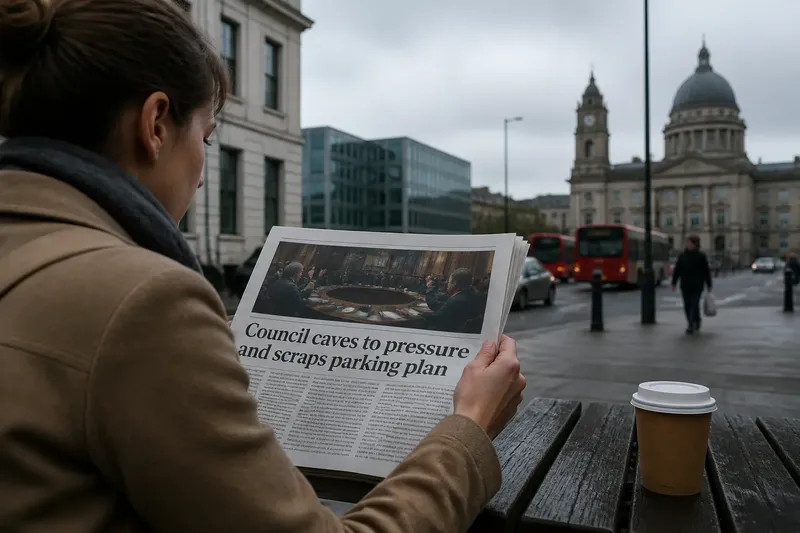
Consider a headline such as “Council caves to pressure and scraps parking plan.” It contains two vivid verbs. “Caves” casts the decision as a surrender; “scraps” says the plan was abandoned. A less loaded version might be “Council drops parking plan after public objections.” That wording still conveys a decision and a sequence, but it does not claim the council acted from weakness.
Do not replace a vivid word automatically. First notice what it contributes. Is the verb naming an observable action, interpreting a motive, or compressing a complicated process into a dramatic image? Those are different jobs, even when one word appears to do all three.
Separate the literal claim from the suggestion
Identify the smallest factual claim the verb requires. If a headline says a company “slashes” a route, the literal claim is that it reduces or removes service. The word may also suggest a severe cut, abruptness, or indifference. Those extra notes are implications, not necessarily additional facts.
This distinction is especially useful with verbs that carry a built-in verdict. “Admits” generally suggests that someone acknowledges something they might prefer to conceal. “Boasts” implies self-congratulation. “Refuses” can suggest a deliberate rejection, while “does not approve” may describe the same outcome without stating why. Read the verb as a bundle: action at the center, attitude around it.
- Observable action: If the story describes a completed event, then name that event; if it offers only a prediction, then preserve the uncertainty.
- Agency: If the story identifies who acted, then retain that actor; if the cause remains unknown, then do not assign one.
- Motive: If the article documents a stated reason, then attribute it to its source; if it does not, then avoid claiming to know why someone acted.
- Evaluation: If the verb praises, blames, ridicules, or dramatizes, then check the supporting details; if those details do not support the judgment, then retell the action more neutrally.
- Certainty: If the story reports an allegation or possibility, then keep that status in your wording; if it reports an established outcome, then describe it as such.
Keep the implied meaning in view without treating it as a lie. A headline can use a defensible verb that still steers attention toward one interpretation. Your reading gets sharper when you can say, “This states that the plan was withdrawn; it suggests the decision was a retreat.”
Check the verb against the article’s evidence
Open the story and find the passage that supports the headline’s action word. The opening paragraphs may repeat the headline’s framing, so look for the specific event: a quoted statement, a recorded decision, a filing, or a description of what changed. Then compare the verb’s force with the evidence’s force.
Imagine a headline says, “Agency admits it missed safety review.” The story reports that an agency spokesperson confirmed the review was not completed, but says nothing about concealment or a prior denial. “Confirms” may fit the stated fact more precisely than “admits,” because the article establishes acknowledgment but not necessarily reluctant confession. The headline’s verb can still be understandable shorthand; the important point is not to add an unreported motive to your own account.
Pay attention to attribution. “The governor misled voters” presents a conclusion in the outlet’s voice. “Opponents say the governor misled voters” reports an accusation. “A review found that the statement was inaccurate” identifies a different basis for the claim. A verb can make an allegation sound like an established finding if the headline leaves out who is making it.
Also note the difference between the headline’s tense and the story’s status. “Court blocks rule” may describe a temporary order, not a final ruling. “Company abandons project” may refer to a proposal being paused while a decision remains pending. Look for qualifiers such as “temporarily,” “plans to,” “according to,” and “could.” They may narrow the claim more than the headline’s compressed wording does.
Notice when a verb assigns blame or removes an actor
Some verbs place responsibility directly on a person or institution: “cuts,” “delays,” “rejects.” Others make agency hazy: “funding disappears,” “deadline slips,” “violence erupts.” The second group may be accurate when the cause is unknown, but it can also hide decisions that the article later describes. Ask whether the story identifies an actor the headline has left out.
The reverse problem happens when a headline gives one person more control than the evidence supports. “Director kills expansion” suggests a direct decision. If the article says a board voted to halt the plan after several departments raised concerns, the headline may compress a shared process into a single person’s action. Compression is normal in headlines; watch for it when it changes who seems responsible.
Say a school district headline reads, “District shuts three bus routes.” The article explains that the routes will not run during a driver shortage, while officials seek replacements. The observable claim is that the routes are not operating; the headline also invites readers to infer a permanent cut. If the article confirms the pause and its stated cause, a fair retelling is: “The district paused three routes during a staffing shortage.”
How do common headline verbs change the claim?
Does “admits” mean the person confessed?
Not by itself. It signals acknowledgment and often hints at reluctance or fault, so check whether the article establishes a confession, a correction, or simply confirmation of a fact.
Does “slams” describe a specific action?
Usually, it characterizes the tone or intensity of criticism rather than naming a precise action. Read the quoted remarks and attribution to see whether the word adds a judgment beyond the criticism itself.
What should I do with “could” or “may”?
Treat these as limits on the claim, not decorative wording. They say an outcome is possible rather than settled, so do not repeat the headline as if the event has already happened.
Can I compare two outlets’ verbs?
Yes, but compare the claims each verb makes, not just which one sounds more dramatic. Check whether both outlets describe the same event, evidence, and degree of certainty before deciding that one has changed the story.
Use a short sequence before repeating the headline
When a story matters, run the wording through a compact close-reading sequence. The sequence gives you a cleaner way to explain what you have read to someone else.
- Quote the exact verb. If the headline says “considers,” then keep that wording in your notes; if it says “approves,” then record the stronger claim rather than relying on memory.
- State the bare action. If the article describes a concrete event, then translate the verb into that plain action; if it gives no event, then mark the claim as an allegation, plan, or possibility.
- Name the extra suggestion. If the word implies reluctance, force, failure, success, or certainty, then note that implication; if it adds no clear implication, then do not invent one.
- Find support in the story. If a passage, filing, or attributed statement supports the action, then use it as the basis for your retelling; if no support appears, then avoid repeating the headline as established fact.
- Keep the limits. If words such as “alleged,” “temporary,” “planned,” or “could” affect what is known, then preserve them; if the article establishes a completed outcome, then do not add uncertainty that it does not contain.
- Retell the claim at the same strength. If the evidence supports a firm outcome, then describe that outcome; if motive or result remains unclear, then say so rather than making the claim firmer.
Imagine you see a headline saying, “Council caves and scraps parking plan.” The story says the council voted to withdraw the proposal after residents objected, but does not describe private deliberations or say that officials felt pressured. First, record the verbs “caves” and “scraps.” Next, translate them: the council withdrew the proposal after objections. Then note the extra suggestion in “caves”: that the decision was a surrender. Check the vote description for support and retain the stated sequence, while leaving motive unclaimed. Your resulting retelling is, “The council withdrew its parking proposal after residents objected; the article does not establish why officials made the decision.” It preserves the observable action and timing without adopting the headline’s judgment.
Let the verb guide a more precise retelling
The verb in a headline can change the whole story because it tells readers not only what happened, but how to interpret the action. When you slow down over that word, you can separate an event from its framing, an accusation from a finding, and a possible outcome from a completed one.
Before forwarding a link or repeating its headline, try putting the claim into a sentence you would be comfortable defending: “The article reports that…” That small change makes attribution visible and gives you room to preserve uncertainty. A careful reader need not strip every headline of character; keep the headline’s suggestion from quietly becoming your own fact.