Interview, Document, or Data Table: Start with the Question
Choose interview, document, or data table sources by matching each to a precise reporting question, so your next inquiry yields evidence readers can assess.
The common mistake in choosing news sources is to begin with what is easiest to obtain: an available interview, a polished report, or a spreadsheet sent by a contact. That shortcut can leave the central question unanswered—and make a confident story out of evidence that points somewhere else. A better starting point is the exact thing you need to establish.
Write the question before picking the source
Make the reporting question narrow enough to test. “What happened at the meeting?” could mean what was decided, what participants understood, or what they later remembered. Those are different claims, and they call for different evidence.
Try phrasing the question so its answer could be checked: What did the agency authorize? Which neighborhoods were included in the notice? How did a named official explain the decision? A question that contains a date range, a defined group, or a specific action gives you a better way to judge whether a source fits.
Then ask what kind of evidence would answer it directly. A person may explain reasoning or recollection. A document may record what was formally written or issued. A data table may show a pattern across entries, if its categories and collection methods suit the question.
Interviews reveal memory, interpretation, and motive
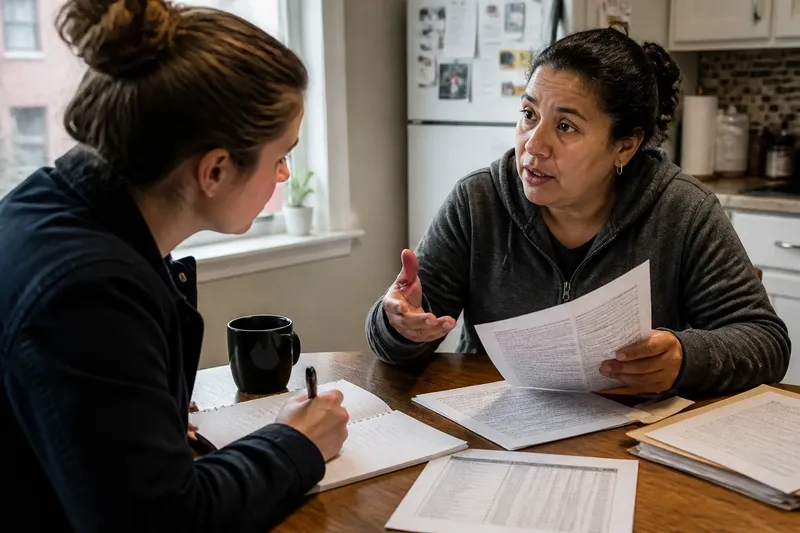
An interview is especially useful when the story needs a person’s account, explanation, or firsthand description that a record does not capture. A resident can describe how a notice reached them; a department spokesperson can explain the agency’s stated rationale. Neither account, by itself, establishes every detail it contains.
Separate what the source directly observed from what they inferred or heard from someone else. Ask when they learned the information, what they remember clearly, and which records might help confirm names, dates, or wording. A person’s authority to speak for an organization is also distinct from personal knowledge of an event.
Interviews can answer “Why did you choose this option?” better than a table can. They are less suited to establishing how often an event occurred across a large group unless the account is paired with broader evidence. A useful interview question invites detail without quietly supplying the answer: “What did you understand the notice to require?” leaves more room than “The notice was confusing, wasn’t it?”
Documents establish what was recorded
Documents work well for questions about official language, recorded decisions, stated rules, and the sequence of written actions. A signed order, meeting minutes, contract, email, or public notice can show what its author put on the record. It cannot automatically establish that the recorded statement was accurate, that everyone understood it, or that it was carried out.
Inspect the document’s surroundings as well as its most quotable line. Check who created it, who received it, whether it is a draft or final version, and whether an attachment or later revision changes its meaning. A clipped excerpt may omit the qualification that makes the passage intelligible.
Distinguish a document’s status from its contents. A signed policy may establish the rule as written; determining how staff applied it may require interviews, case records, or another source. A memo describing an event is evidence that its author described the event that way—not necessarily independent confirmation of every detail.
Data tables answer questions about patterns
A table is useful when the question concerns counts, comparisons, distributions, or changes across a defined set of records. It can help answer which locations appear in an agency’s complaint log, for example, provided the table actually covers the relevant locations and time period.
Before interpreting a pattern, read the labels and notes. What does each row represent: a person, a visit, a complaint, or a record? Are categories mutually exclusive? What is excluded, and how were entries collected? A change in recorded complaints might reflect reporting behavior or a revised form, not simply a change in the underlying problem.
Ask for the table’s source file or documentation when the summary leaves those questions open. Check whether the totals can be reconciled with the listed categories and whether missing entries are marked. A neat column of figures can look decisive while answering a different question from the one in your story.
Match the source to the claim you plan to make
Think of source choice as a fit between the wording of a claim and the reach of its evidence. “The notice said applications closed on Monday” is a claim about written wording. “Residents understood the deadline to be Monday” is about people’s understanding. “Most applicants submitted after Monday” is a claim about a defined group and its records.
Say you are reporting whether a city’s new notice reached renters in one district. The notice can establish what the city published, but not who saw it. An interview with a renter can describe one person’s experience, but not the reach across the district. A distribution table could help if it records deliveries by location; if it records only copies printed, it answers a narrower question. The reporting question determines which gap remains.
When a source cannot carry the full claim, narrow the wording rather than stretching the evidence. If the table covers logged complaints, say “logged complaints,” not “all complaints.” If one interview provides an account, attribute it as that person’s account. If a document states an agency’s position, identify it as the agency’s stated position.
How do you choose between source types?
Which source is best for what someone remembers?
An interview is the direct route to a person’s recollection, but memory is not the same as a contemporaneous record. Ask about the person’s vantage point and look for messages, notes, or records that can clarify details.
Which source can establish an official decision?
A final order, signed notice, or approved minutes may establish the decision as formally recorded. To learn how it was implemented or understood, seek evidence that addresses those separate questions.
Can a data table prove why a pattern occurred?
A table can describe a pattern within the records it covers, but it usually cannot establish the cause on its own. Use it to identify what needs explaining, then seek sources that can speak to the possible reasons.
What if the available source only partly answers the question?
State the narrower claim the source supports and identify the unanswered part in your reporting. A precise limit is more informative than wording that makes partial evidence sound complete.
Keep a source note beside each claim
As you report, jot down the claim, its source, and what that source does not establish. This small habit helps separate a document’s wording from an interviewee’s interpretation and a table’s pattern from a causal explanation. It also makes later editing easier: if a sentence outruns its evidence, you can see where the leap occurred.
For this kind of reporting, the useful search phrase is “interview, document, or data table.” Treat it as a choice made claim by claim, not a ranking of source types. The sharpest next question is often the one that exposes what your current source cannot tell you.